
Rust Client
Auto-generated Rust instruction builders for off-chain use and testing.
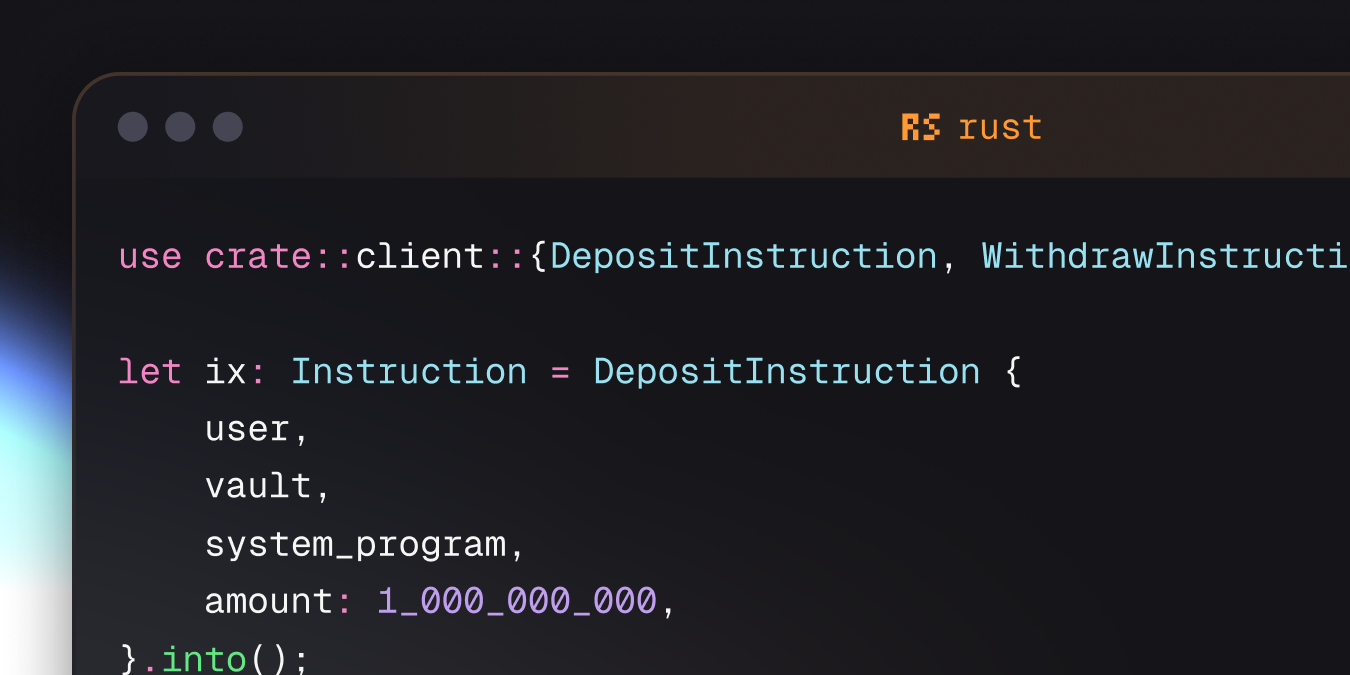
#[program] generates a client submodule with typed instruction builders. Each instruction gets a struct that converts into solana_instruction::Instruction via .into().
Inline Client Module
The module is gated behind #[cfg(not(target_os = "solana"))] -- it only compiles for off-chain targets (tests, CLI tools, scripts). For the vault program:
use crate::client::{DepositInstruction, WithdrawInstruction};

let ix: Instruction = DepositInstruction {
    user,
    vault,
    system_program,
    amount: 1_000_000_000,
}.into();
Each struct has a field for every account (as Address) plus every instruction argument. Account metadata (writable, signer) is derived from your accounts struct automatically.
If your instruction uses CtxWithRemaining<T>, the struct includes an additional remaining_accounts: Vec<AccountMeta> field.
Standalone Crate
quasar idl also generates a standalone crate at target/client/rust/<name>-client/ with the same instruction builders. Use it when your test suite or CLI tool lives outside the program crate:
[dev-dependencies]
my-program-client = { path = "target/client/rust/my-program-client" }
The standalone crate depends only on solana-instruction and solana-address -- no dependency on your program.
Sending Transactions
Combine generated instructions with solana-client:
use solana_client::rpc_client::RpcClient;
use solana_sdk::{signature::{Keypair, Signer}, transaction::Transaction};

let client = RpcClient::new("http://localhost:8899");
let payer = Keypair::new();

let ix: Instruction = DepositInstruction {
    user: payer.pubkey(),
    vault: vault_pda,
    system_program: solana_sdk::system_program::id(),
    amount: 1_000_000_000,
}.into();

let tx = Transaction::new_signed_with_payer(
    &[ix],
    Some(&payer.pubkey()),
    &[&payer],
    client.get_latest_blockhash()?,
);
client.send_and_confirm_transaction(&tx)?;